Go to: ↓ contenthomepagesearchnavigation

Induction heating - technology

Induction heating

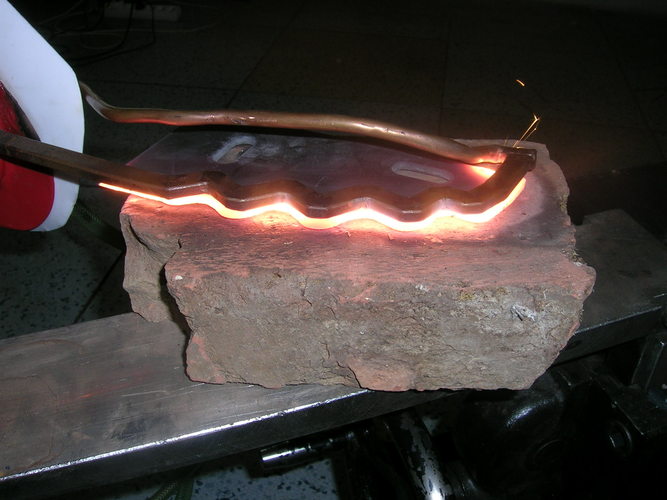
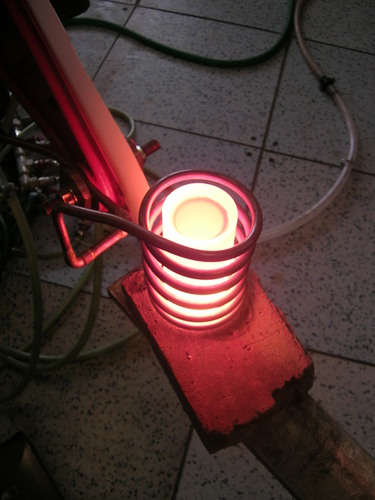
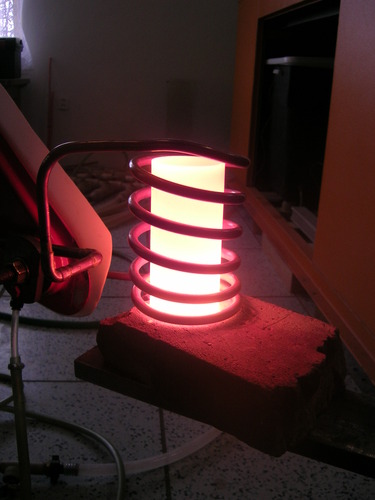
During induction heating, the heated material passes through a water-cooled working coil (the so-called inductor), which is fed with a current (10 to 3000A) at medium (3 to 50kHz) or high frequency (50 to 500kHz) from a medium-frequency or high-frequency generator. The local heating of the material in the immediate vicinity of the inductor then takes place by induction, which is a direct application of Lenz's and Joule's laws. According to Lenz's law of induction, an electromotive force exists in every electrical conductor placed in a varying magnetic field, and induced currents known as eddy currents therefore arise in it. These currents generate Joule heat directly in the heated material.

Advantages of induction heating

  • no contact is required between the processed material and the coil
  • high power density and heating speed
  • good control of metal temperature
  • precise definition of heated zones
  • simplicity of operation
  • great flexibility of regulation
  • good efficiency
  • good working conditions and minimal negative environmental impact

The points highlighted in bold directly determine the irreplaceability of induction heating in engineering practice, because without these prerequisites some of today's structural components and assemblies simply could not be produced. For example, hardening a turbocharger shaft to a depth of 1-1.5mm to the required hardness of +-5 HRC degrees in repeated production series would be impossible with a gas burner or a resistance furnace. In terms of efficiency, induction heating is an order of magnitude more energy-efficient than a continuous gas or resistance furnace. For example, a 100kW continuous furnace used for heating steel parts can be replaced by an HF generator with an average power of 25kW, which locally heats the workpiece within a matter of seconds, simply because the energy required for heating is directed exactly where it is needed.

At present, the vast majority of medium-frequency and high-frequency induction heating in the Czech Republic is performed using old generators from the 1960s, 70s and 80s. The medium-frequency generator design from the 1970s is still used by many suppliers in new generators to this day; in the high-frequency field these are mainly products of the ZEZ Rychnov n. Nisou company (GV series), based on tubes from the then Czech manufacturer Tesla Vršovice, produced in series of hundreds. In some cases you may also come across vacuum-tube HF generators from SIEMENS (production definitively ended in 1993) or the Swiss BROWN&BOWERI from the late 1960s. There are currently approximately 150 of these generators in the Czech Republic, of which about 50 to 60 are in operation (information from the international conference "22nd International Conference on Heat Treatment", 25 - 27 November 2008, Brno, Czech Republic). Apart from the now critically severe shortage of spare parts – above all high-voltage capacitors, transformers and, to some extent, the tubes themselves – there are also problems with the presence of high voltage (up to 30kV) and very low efficiency, which theoretically approaches 60% (in reality 40 - 50%). The rest of the electrical energy is converted into heat, which must be removed from the tube generator area by additional systems. In the case of water cooling, which is used almost exclusively here, the re-cooling of the circulating medium and its excessive consumption must also be addressed. A vacuum-tube generator must be "ramped up" slowly, i.e. the tube must be pre-heated, which causes production downtime. In the event of a tube failure, which will always occur (given the principle of its operation), a new one must be procured, the purchase cost of which often amounts to 2/3 of the price of the entire generator and runs into tens, or more likely hundreds, of thousands of crowns. A new tube also ages during long-term storage, shortening its service life without ever being used in operation.

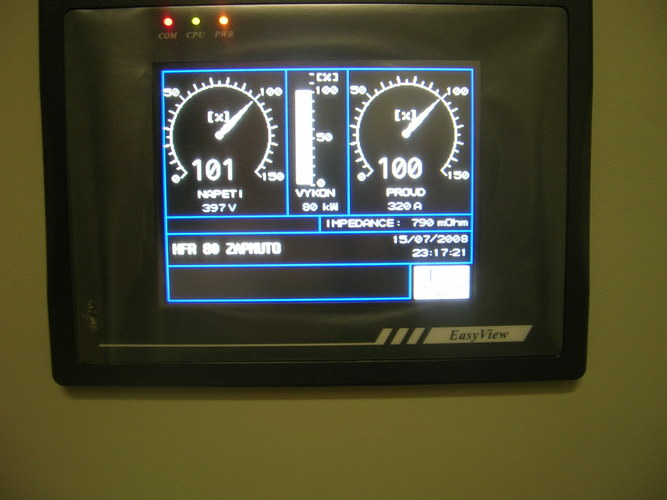
In the coming years, the current situation in the field of vacuum-tube HF generators used for industrial induction heating is permanently unsustainable. For this reason, Rajmont s.r.o. has developed series of solid-state HFR HF generators serving as a direct replacement for the obsolete types listed above. These are primarily equivalents of the most widely used GV22 generators with 22kW HF output, GV80 (80kW) and also GV11. The operating frequency of these generators (typically 300kHz) has been retained, and the generators can be adapted to frequencies in the range of 50 to 500kHz according to the customer's requirements in the given application. The HF unit is powered by a modern pulse switched-mode supply based on "intelligent" IGBT modules. Using a fully solid-state design (MOSFET and IGBT transistors) brings the following advantages:

  • high efficiency - 90%
  • theoretically unlimited service life - transistors do not age
  • roughly half to one third of the installation footprint
  • low cooling water consumption
  • instant ramp-up to full power
  • up to 1000x cheaper repairs in the event of a failure

It is evident from the above that the advantages of solid-state HF generators for induction heating clearly outweigh those of vacuum-tube generators, and their development and industrial deployment is attractive and desirable.

Photos

Go to: ↑ Contenttop of the pagehomepagesearchnavigation

Go to: ↑ contenttop of the pagehomepageSearchnavigation