
High-frequency generators - technology
High-frequency generators
Adaptive control unit of the medium-frequency and high-frequency generator
Apart from the solid-state power section itself and the parallel resonant circuit, the fundamental building block of a solid-state HF generator is above all the control unit, which determines – based on suitable feedback signals – the precise switching instants of the power transistors. The requirements on switching timing are extremely demanding for generators with an operating frequency of 5 to 500kHz, in the order of units of nanoseconds. If the power section were switched at the wrong moment, it would mean the destruction of the power stage, which operates in ZCS (zero current switching) mode, i.e. switching at zero current. The control must be able to safely shut down the generator even in the event of a hard short circuit at the output, for example when the working inductor fails. In addition to the requirements listed above, induction heating also requires dealing with the issue of load impedance changes. In this context, "load" means the heated metal workpiece. "Impedance" means the ratio between the HF voltage and current, which affects the ratio of the supply DC voltage and current. It should be noted that the full nominal power can only be delivered to the load at 100% matching – when the impedance is optimal. "100% matching" means a situation where the relative values of the DC voltage and current supplying the HF generator are identical with respect to their maximum values. When heating a ferromagnetic material (typically steel and its alloys), the initial impedance in the cold state is relatively low. As the part heats up, the impedance gradually rises until the critical point of the loss of ferromagnetic properties (the so-called Curie point – around 730°C), when the hysteresis losses in the material disappear and the impedance rises by 100 to 200%. The operating frequency also changes by units to tens of percent. The initial – and therefore also the final – impedance during generator operation is determined primarily by the choice of inductor, which is dictated by the customer's technological requirements and cannot be changed arbitrarily (this is a diametrically different situation from HF welding generators, where a specific working inductor is always clearly prescribed for a given welded tube diameter and material, and its unprofessional use or substitution is regarded as a breach of binding technological operating conditions, with the possibility of voiding the generator warranty). As the impedance and frequency change, the power unit unfortunately needs to be switched at different time instants, which in practice means necessary corrections in the order of units of nanoseconds. The control unit must be able to perform this function and ensure reliable start-up and switching of the power unit for any customer inductor.
Impedance regulator
The task of the control unit is to adapt to these changes and protect the power stage from destruction. At the same time, however, it is necessary to deal with situations where, for example, the operating impedance is too high and the DC supply voltage reaches its 100% maximum at only 10% of the current. The resulting maximum power of the generator in this situation is then only 10% of the nominal value (P=U*I), which makes the intended heating impossible. There are cases where, for technological reasons, the shape and size of the inductor cannot be changed, and the only solution is to modify the arrangement of the resonant circuit of the HF generator. With old vacuum-tube generators, various air-core transformers were used in these cases, or the capacitors were changed. With solid-state generators, which unlike tubes do not work with high voltage, the use of matching transformers is highly inefficient and significantly degrades the efficiency of the entire system. There is the option of replacing the resonant capacitors, which is, however, just as time-consuming and operationally inefficient as with vacuum-tube equipment.
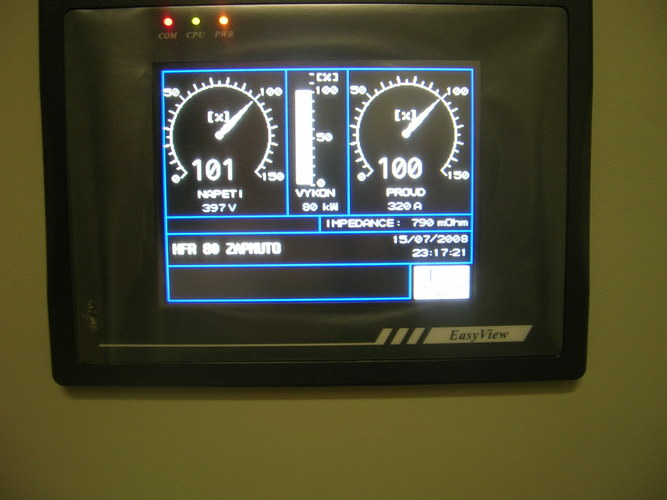
On request, HFR generators are equipped with an impedance regulator, which stabilises the operation of the generator regardless of the nature of the "load".
Photos
Go to: ↑ Content ↑ top of the page ↑ homepage ↓ search ↓ navigation


