
Induction welding
Induction welding
HFR high-frequency generators for the induction welding of tubes and profiles
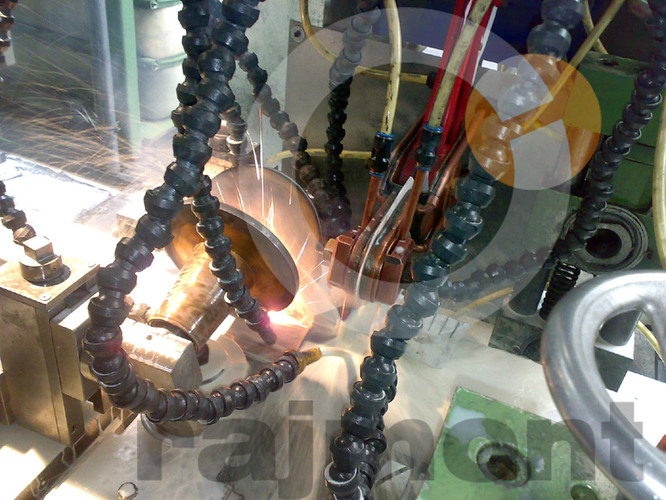
Roll-forming lines are used for the production of closed profiles. The input material is a steel strip with a width corresponding to the circumference of the future profile, wound into a so-called coil. In the first (forming) part of the line, the strip is rolled into a tube and the resulting seam is welded in the so-called welding node. The welded tube then passes through the second (calibration) part of the rolling line, where further forming produces the final profile.
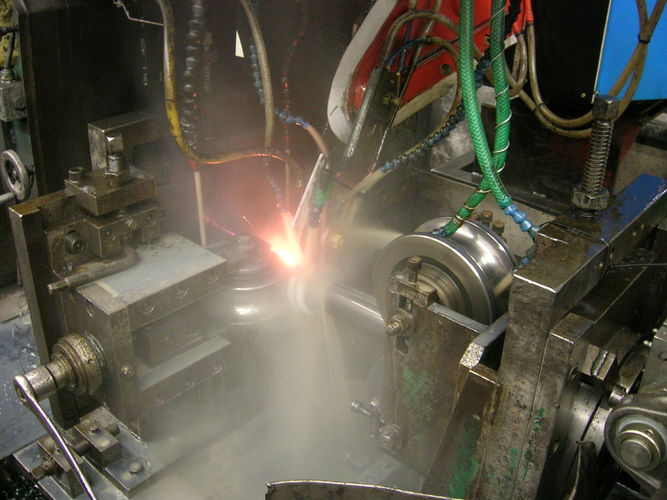
During induction welding, the tube with the unwelded seam passes through a water-cooled working coil (the so-called inductor), usually with one to three turns, which is fed with a relatively high current (0.5 to 10kA) at a high frequency (200 to 400kHz) from a high-frequency generator. The local melting of the material edges and the subsequent welding then take place by induction heating.
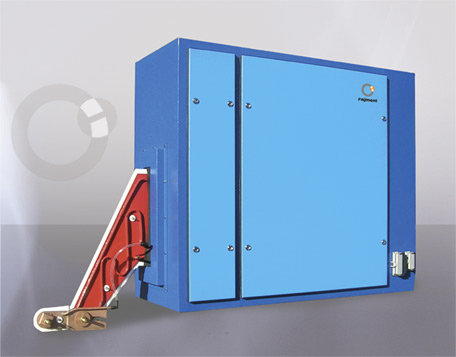
Advantages of fully transistor-based HFR generators for induction welding
- high efficiency 80- 90%
- theoretically unlimited service life - transistors do not age
- roughly half to one third of the installation footprint
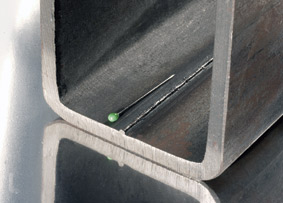
- higher weld quality
- low cooling water consumption
- smooth weld bead – thanks to the perfectly smoothed DC supply
- up to 1000x cheaper repairs in the event of a failure.
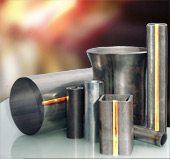
In addition, the new range of HF generators allows – thanks to the perfectly smoothed DC supply – the regulation of HF power from 0 to 100% while maintaining constant weld quality and parameter stability, which is an indisputable advantage over the competition.
Disadvantages of vacuum-tube generators for induction welding
The design of the vacuum-tube high-frequency welding generator has remained practically unchanged since the 1950s and is still produced by some foreign manufacturers to this day. The disadvantages of the vacuum-tube HF generator can be roughly summarised, in order of importance, as follows:
- low efficiency of converting electrical energy from the mains into high-frequency form (the maximum theoretical efficiency is 62%, but typically only 45 – 50% in operation)
- tube ageing – physically inherent and inevitable (roughly 3 years).
- ageing of a new tube even during storage (an indispensable and very costly spare part)
- the need to work with high voltage (12 - 30kV)
- grainy weld – caused by the thyristor DC supply
- strict requirements on cooling water quality
The biggest disadvantage of vacuum-tube welding systems is undoubtedly their very low efficiency. If, for example, a vacuum-tube welding HF generator with an output power of 200kW is operated in practice, its input power must be 400kW. The remaining (unneeded) 200kW is dissipated into the cooling water, which then has to be expensively re-cooled.
Photos
Video
Enquiry form
Go to: ↑ Content ↑ top of the page ↑ homepage ↓ search ↓ navigation


